.png)


Baling Wire’s Role in the Circular Economy: Small Component, Big Impact

Updated: Sep 8
When people talk about the circular economy, they usually think of big concepts: renewable energy, recycled materials, and closed-loop systems.
Baling wire rarely makes the list.
But if you walk through any recycling facility, MRF, distribution center, or scrap yard, you’ll see it everywhere. Wire is the quiet connector between loose material and a usable, shippable commodity.
In a very real way, baling wire is a small component with a big impact on sustainability and efficiency.
This article explores:
- How baling wire supports material recovery
- Why reliability matters for sustainability, not just operations
- Trends we’re seeing from baling wire users
- Practical steps facilities can take to align wire choices with circular goals
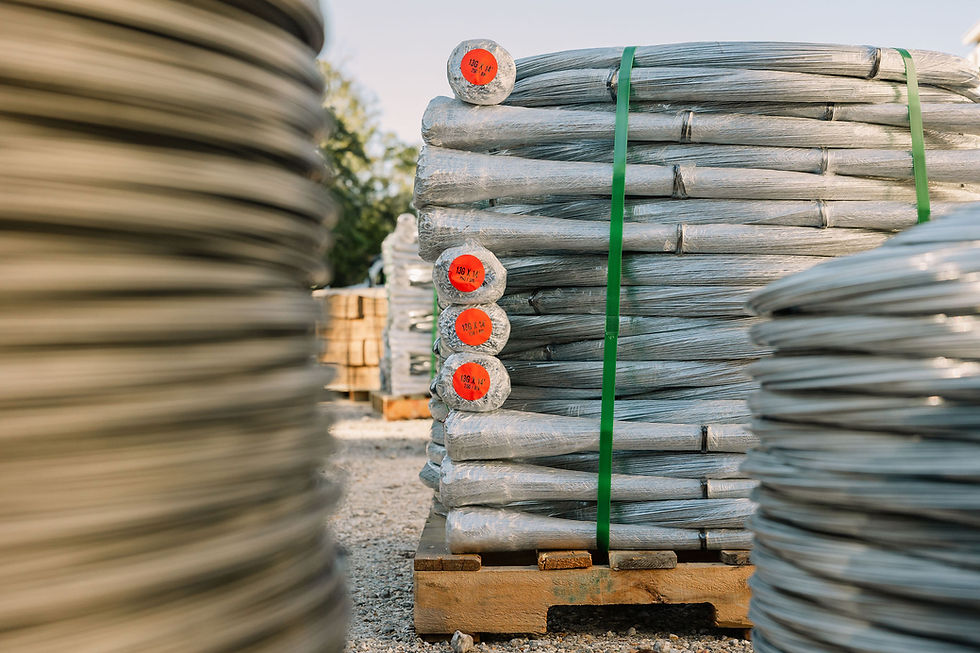
Recycling and recovery depend on moving large volumes of loose material through a series of steps—collection, sorting, compacting, shipping, and reprocessing.
Wire shows up at a key moment: turning loose material into dense, transportable bales.
Without reliable baling:
- It’s harder to move large volumes efficiently
- Loads may not meet density or integrity requirements
- Materials are more likely to be contaminated or lost
Well-baled material is easier to store, stack, ship, and process. That increases the likelihood that recyclables actually make it to a reprocessor and back into new products—rather than being downgraded or discarded along the way.
Why reliability supports sustainability
It’s tempting to think of “sustainable” as “using less.” But in an industrial setting, sustainability is often about doing more with the same resources and reducing waste at every step.
Reliable baling wire supports that in a few ways:
1. Fewer broken bales = less waste and rework
When bales fail, materials can spill, get contaminated, or require reprocessing. That’s more energy, labor, and equipment time for the same tonnage.
2. Consistent bale density = efficient transport
The denser and more consistent your bales, the more you can move per truckload. That means fewer trips and less fuel per ton of material.
3. Stable stacking = safer, more efficient storage
Bales that retain their shape and integrity stack more easily, reducing the risk of collapse and allowing better use of vertical space.
In each case, the wire you choose indirectly affects resource use, emissions, and safety—key components of a circular economy.
Trends we’re seeing from baling wire users
Across recycling and materials handling, a few clear trends are emerging:
- Higher bale densities
Facilities are pushing for denser bales to optimize shipping. That increases the demand for reliable, high-performance wire, especially double-loop ties and properly spec’d gauges.
- More mixed and challenging materials
As new packaging types and composite materials enter the waste stream, balers are handling more complex loads. Wire needs to keep up.
- Increased focus on uptime
As throughput targets rise, unplanned downtime is more visible and costly. Wire-related stoppages are less tolerated.
- Closer attention from downstream buyers
Mills and reprocessors are closely monitoring bale quality and contamination. Broken, misshapen, or under-tied bales are more likely to be flagged.
In this environment, baling wire is no longer just a commodity—it’s part of a performance system.
How to align your wire choices with circular goals
You don’t have to overhaul your entire operation to start making more circular, efficient decisions. Here are a few practical steps:
1. Audit bale integrity and breakage
Track how often bales fail and the conditions under which they fail (material type, density, storage duration, handling steps). If you spot patterns, wire specification might be part of the solution.
2. Review bale density vs. transport efficiency
Are you maximizing the weight per truckload without compromising safety or material quality? The right wire can help you safely support higher densities.
3. Match wire types to material streams
You may not need the same wire everywhere. For example:
- Single-loop for lighter paper/OCC lines
- Double-loop for high-density or high-value materials
- Straight & cut for certain auto or custom operations
4. Talk to your wire supplier about your circular and efficiency goals
Share your priorities: fewer re-binds, higher densities, smoother automatic feeding, etc. A good partner can propose changes in wire type, gauge, or configuration to support those goals.
5. Pilot, measure, then roll out
Test any changes on a single line or shift first. Track bale integrity, operator feedback, downtime, and transport metrics. Then expand what works.
The bottom line: small component, big leverage
Baling wire will probably never be the star of your sustainability report—and that’s okay. But it is a small lever with outsized impact.
When you choose wire that supports:
- Fewer failures
- More efficient transport
- Safer stacking and handling
- Reliable performance at higher densities
you’re reducing waste, improving safety, and helping more material complete the loop from waste back to resource.
If your facility is pushing for higher bale densities, fewer failures, or better transport efficiency, we can help match wire options to your circular and operational goals.
---


Comments